

Renault Group is deeply proud that it is 100% made in France. As an electric car pioneer, the French car manufacturer clearly understood the benefits of bringing together the entire value chain to have greater control over it. Instead of starting from scratch, it built upon long-standing assets to reach its goal. In particular, three Renault Group industrial sites located in northern France (Douai, Maubeuge, Ruitz) were brought together and turned into a figurehead of French electric mobility: ElectriCity. The ecosystem is entirely dedicated to electric cars and “sits at the heart of the European market”, according to its managing director, Luciano Biondo.
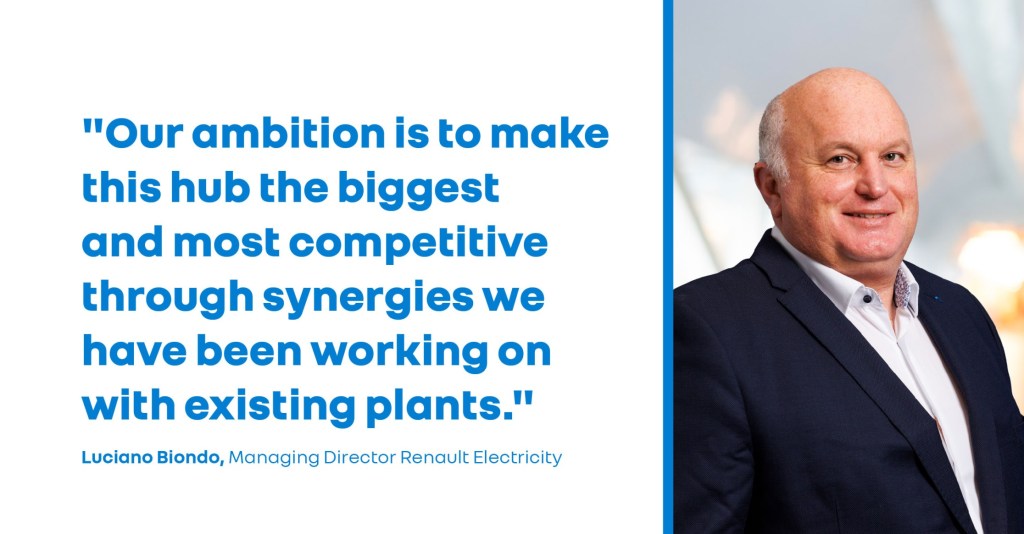
“Our ambition,” he continued, “is to make this hub the biggest and most competitive through synergies we have been working on with existing plants.” Thus, in 2021, the Douai site produced its first electric vehicle: the Megane E-Tech 100% electric. The Maubeuge site is specialised in vans and will produce all electric models as of 2023. Ruitz will soon become home to manufacturing of electrical components and battery trays. An additional feature of the ecosystem is the Cleon site (near Rouen), which will provide electric motors. In total, by 2025, half a million vehicles (of which nearly all will be electric) are expected to leave ElectriCity’s production lines each year.
“Affordable and sustainable” electric vehicles
Having everything in one place has many advantages. First of all, a competitive edge. Having 80% of suppliers within a 300-kilometre radius “improves overall quality because they help us improve our response time,” said Luciano Biondo. Stock levels and the transport of spare parts are lower, as are the related CO2 emissions. The combined benefit helps the Group achieve the main objective of the ElectriCity hub: to “provide affordable and sustainable vehicles.” Luciano Biondo added that everything on the site has been designed to reduce the carbon footprint as much as possible: from the use of renewable energies (e.g. the installation of a geothermal plant and a biomass boiler on the Douai and Maubeuge sites respectively) to leveraging digital technology to reduce energy use… Then there is the issue of industrial sovereignty.
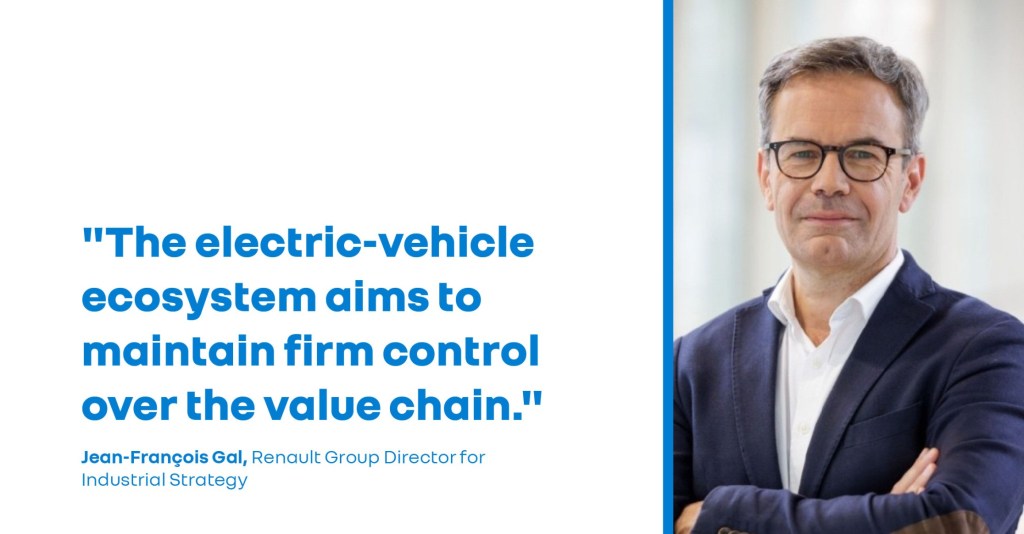
“The electric-vehicle ecosystem aims to maintain firm control over the value chain”, explained Jean-Francois Gal, Renault Group Director for Industrial Strategy. He sees it as a strategic asset to ensure rapid growth of Ampere, the Group’s new entity soon to be entirely dedicated to electric vehicles and software.
EV battery gigafactories a stone’s throw from ElectriCity
Furthermore, ElectriCity is an industrial ecosystem built on strategic alliances with external partners. The Group partnered with French start-up Verkor and the Envision Group to build two EV battery gigafactories: the first in Dunkirk and the second in Douai, right next to the factory. The same rationale went into establishing raw material and electronic component supply chains, as is the case for microchips that were in serious shortage following the COVID-19 crisis. Renault Group has entered into a partnership with STMicroelectronics, a French-Italian multinational that markets electronic chips, in order to reduce such risks. For the particular case of lithium, an essential metal component of EV-battery production whose price rose dramatically (up to +1,400%) between 2020 and 2022 , Luciano Biondo also mentions several partners to secure its production. One such partner is the Australian start-up Vulcan, which produces a ‘zero-carbon’ lithium in Germany.
A time of short loops
In essence, ElectriCity is also a first milestone on the path to a burgeoning era for the automotive industry. The rationale of short distribution loops as reflected in the ground-breaking industrial hub marks a clear break with how business has been done in the past. “Our strategy is no longer one where we source from all over the world, seeking out the lowest possible costs, as we did fifteen years ago. Now, we also seek high performance locally,” explained Jean-François Gal. It must be said that the economic backdrop has also changed. “With logistics costing more,” he continued, “we now know that we can maintain a competitive edge by working with suppliers who are closer to home.” The organisation built around industrial hubs is also being developed by Renault Group outside France, with one such hub in Eastern Europe, and another between Spain and Morocco…“it is a geography-centric approach whereby we make vehicles in the region where our customers need them, so we don’t have to transport high-value parts (e.g. engines) across Europe,” said Jean-François Gal. In addition to technical innovation, the Group is also working on new ways to ensure large-scale deployment of future e-mobility solutions. Once again, it shores up its position as an electric car pioneer.

 Ola E America
Leave a comment